About
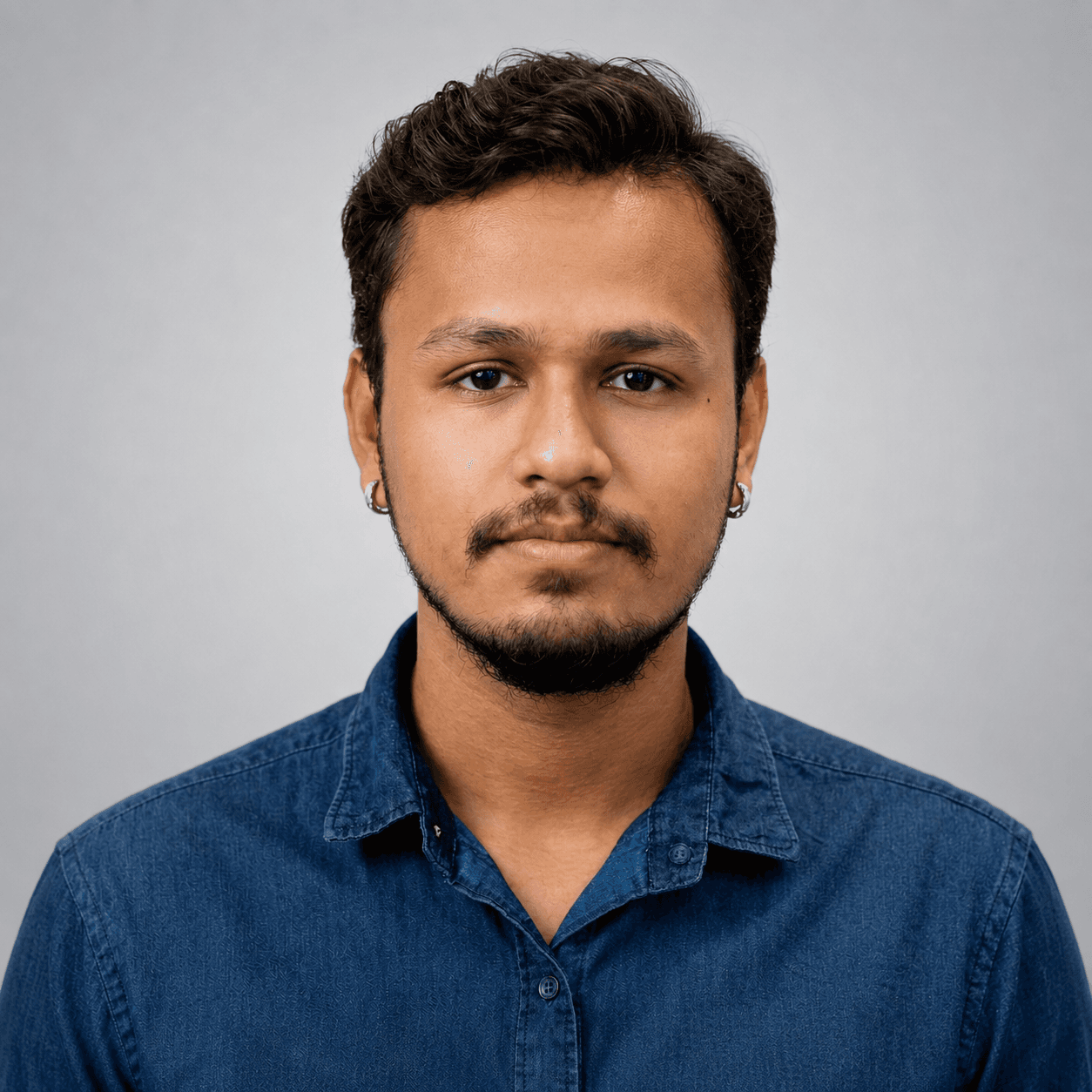
Omprakash Sahani
I did not start with computers
I did not grow up knowing much about computers, software, or technology.
After 12th, I first took admission in Nanoscience and Nanotechnology at Shivaji University. But after some time, I realised it was not the direction I was curious about, so I changed my path and joined a Diploma in Computer Engineering.
When I started, I knew almost nothing about computers. I did not properly know C or C++, or even how programs were written and executed using software. I had to study hard, struggle through many things, make mistakes, and slowly understand them.
Later, I continued with B.Tech in Computer Science and Engineering.
During B.Tech, I was mostly focused on academics and marks. I was learning, but I was not really thinking about building something independently yet.
That curiosity came later.
From building models to understanding what is underneath them
After B.Tech, I was considering graduate study in Data Science, Machine Learning, AI, or Computer Science abroad.
While preparing for that, I realised that academic knowledge alone was not enough. I needed practical experience. I needed to build things.
So I started with applied machine-learning projects—brain-tumor prediction using CNNs, diabetes prediction, and projects related to environment and energy.
At first, I was building them mainly to strengthen my portfolio.
But as I continued learning and building, the question in my mind started changing.
Can I build a model?
became:
What is underneath the model?
How is it trained? How is it evaluated? What happens when it becomes larger? Where does performance go? How do machines communicate with each other? How do we benchmark a system properly? How do we understand why something failed?
That curiosity gradually pulled me toward ML systems, infrastructure, evaluation, benchmarking, distributed systems, performance, and software engineering.
I am also inspired by Andrej Karpathy—not because I know him personally, but because of his curiosity, the way he builds things from first principles, and the way he explains difficult ideas as if they can be understood simply.
How I learn and build
I do not think there is one way to learn everything.
Depending on what I am trying to understand, I read documentation, watch lectures, read papers, ask questions, build a smaller version myself, experiment, and inspect how existing implementations work.
The part I enjoy most is understanding the problem deeply.
Then I like building the first working version, finding what is not working, trying another method, comparing different approaches, debugging, and making the implementation cleaner.
When I get stuck, I usually keep pushing, but not always in the same direction. Sometimes another approach works better. Sometimes I take a break and come back with a clearer mind.
The first thing I want after building something is to understand what I actually built.
I do not want to build something that I cannot explain to myself.
A developer should know what the system is doing, how it works, and how the whole process fits together.
Always learning
I do not think an engineer ever finishes learning.
Technology changes. Tools change. Systems change. New ideas keep coming.
There will always be something I do not know and something I can improve.
For me, engineering is a continuous process:
learn → build → test → understand → improve → repeat
I want to keep getting deeper into ML infrastructure, model-training systems, distributed systems, developer tools for ML, research engineering, and software engineering.
But I do not want to build technology only because it is technically interesting.
I want the things I build to be useful to someone.
That could mean making useful technology accessible to more people, helping developers or researchers work more effectively, making a complex system easier to use, applying technology in healthcare or education, or solving a real everyday problem.
For me, simply knowing that someone genuinely benefited from something I built would mean a lot.
Beyond engineering
I am naturally quiet and introverted, and I like simplicity and being comfortable with myself.
But with the people I am close to—my family and friends—I can be completely different.
I can also be impatient. At the same time, I have learned that some situations need patience, and sometimes stepping away and coming back is better than forcing an answer.
I am ambitious, but I would like that ambition to lead toward something useful—to help other people, to be part of someone's happiness, and to keep improving without losing balance.